Storage: Desktop Organization
Desktop organization is an exercise in cognitive offloading. Physical tools that clutter the working field constantly solicit peripheral attention, inducing attentional residue and subtle task disruption.
The Three Reach Zones
Industrial workstations categorize horizontal workspace into three concentric radial zones centered around the seated operator:
- Primary Reach Zone (0–300mm): The area swept by the hands with elbows remaining bent at 90 degrees. This zone is reserved solely for continuous input tools: split keyboard, precision pointer, and immediate analog notebook. No static clutter should ever encroach here.
- Secondary Reach Zone (300–500mm): Accessible by extending the arms from the shoulder without bending the torso forward. Ideal for the desk shelf, phone stand, headphones cradle, and reference documentation.
- Tertiary Reach Zone (500–800mm): Demands leaning the torso forward or swiveling the chair. Suited for external storage drives, audio interfaces, printer units, and archival book stands.
The Desk Shelf as an Architectural Horizon
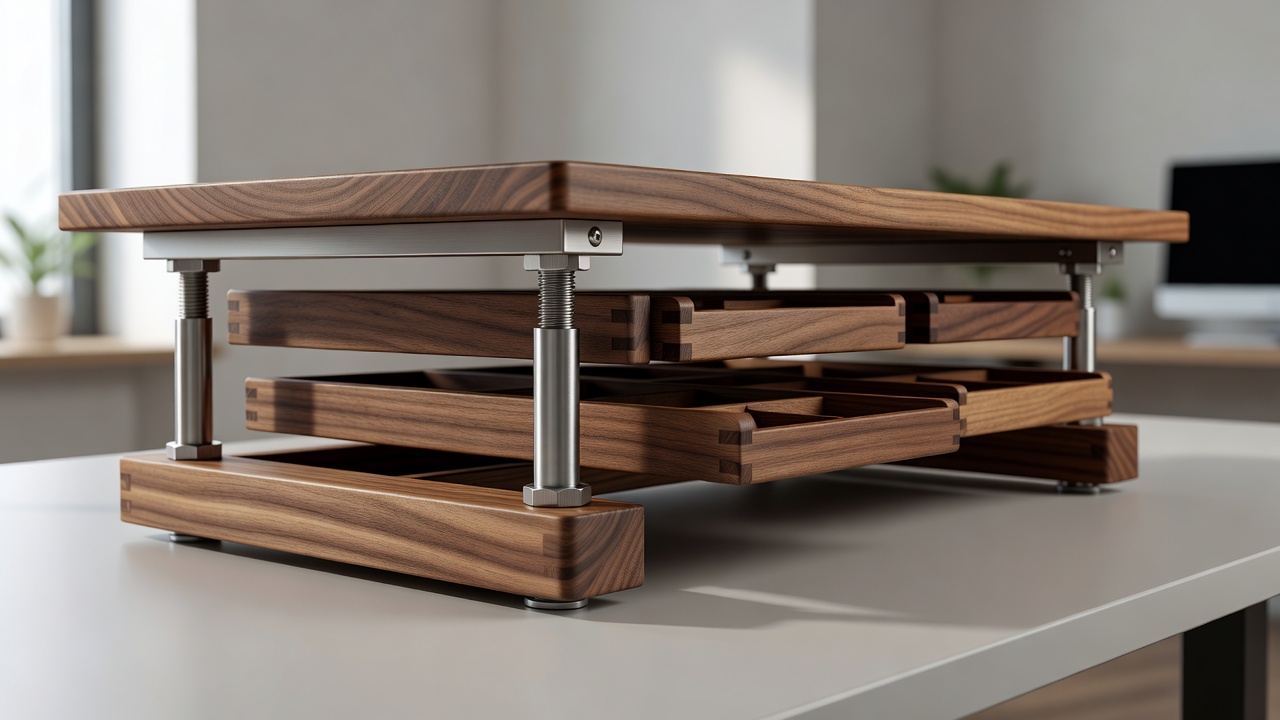
A continuous flat desk inevitably becomes an undifferentiated horizontal dumping ground. By introducing an elevated desk shelf (100 to 120mm in elevation), you establish a second horizontal plane that accomplishes three spatial tasks simultaneously:
- It raises displays or laptop docking stations to proper ocular height without requiring bulky monitor stands.
- It creates an under-shelf dock where keyboards and sketch tablets can be tucked away at the conclusion of a work block, resetting the visual canvas.
- It provides dedicated channels for cable passthroughs, routing peripheral leads out of sight without drilling into the primary timber desk.
DRAWER ARCHITECTURE: SHADOW BOARDS & FELT TRAYS
Pedestal drawers often degenerate into bottomless utility bins where tools collect dust. Apply the classic machinist’s principle of the "shadow board" using modular milled timber or high-density felt sorting trays:
- Every instrument has a single assigned silhouette: Drafting pens, calibers, charging leads, and storage media occupy fixed depressions.
- Immediate visual auditing: A single glance into an open drawer confirms whether a tool has been returned to its home before leaving the studio.
- No stacking: Maintain a single layer of depth; never stack tools or notebooks on top of one another within active drawers.
Vertical Wall Plane Integration
When floor footprint is limited, the wall plane behind the desk becomes your most valuable structural asset. Rather than installing decorative artwork, install a precision-machined steel or matte birch pegboard system. By mounting secondary hardware—such as external audio monitors, camera battery chargers, and reference folders—directly to the wall studs, you free up the desk surface for clear-headed creative execution.